SikhiAt.Net
Learn Sikhi
A first walk through the house of the Guru.
Nitnem Baani, Panj Kakkaar, and Gurmat Maryada for Sehaj Path — curated guidelines for the Sangat.
These notes are a door, not a finish. Sit with Gurbani. Keep sangat.
Ik Onkar
Sikhi boils down to one pure truth: Ik Onkar. One Creator, boundless and undivided by walls, creeds, or borders. The Mool Mantar reveals this One as Eternal Truth, Creative Being, Fearless, Unborn, and known through Guru's grace.
Before that One, titles and caste fall away; everyone stands equal, and privilege does not buy proximity. The entire path fits into three simple rules: remember the Name, earn an honest living, and share whatever you have.
The ten Gurus
One unbroken divine light moved through ten human Gurus—from Guru Nanak Sahib to Guru Gobind Singh Sahib—before sealing itself forever into living scripture. This was not quiet mysticism; it was a revolution for humanity. The Gurus anchored daily life in honest work, remembrance, and sharing. They shattered social hierarchies with open community kitchens (langar), struck down horrific customs like sati to grant women equal dignity, and created the accessible Gurmukhi script for the common people. They founded free cities, dug wells and holy reservoirs where all could bathe together, and pioneered free medicinal dispensaries under Guru Har Rai Sahib Ji—where even royal emperors received rare remedies, while humanity received compassion. In the dark face of smallpox, the child-master Guru Har Krishan Sahib Ji healed the abandoned masses at the cost of his own life. To defend this fragile truth against imperial tyranny, Guru Gobind Singh Sahib forged the Khalsa: saint-soldiers crowned with uncut hair, armed with steel, and sworn to protect the weak without fear or hatred.
At Nanded, Guru Gobind Singh Sahib ended the lineage of mortal masters and enthroned Sri Guru Granth Sahib Ji as the eternal living Guru. A Sikh bows neither to mortal kings nor cushions of flesh, but entirely to the living sovereignty of the Word.
Guru Granth Sahib Ji
Sri Guru Granth Sahib Ji is 1,430 Angs of living Word—the Guru’s eternal voice woven across 31 musical raags, uniting the hymns of the Gurus and enlightened saints of diverse origins into one unbroken song. Far beyond mortal literature, it unveiled cosmic realities centuries before modern science: declaring countless galaxies and realms long before telescopes ("lakh aagasa aagas"), describing the primordial cosmic void before creation ("arbad narbad dhundhookara"), and detailing the origin of water and life through thermodynamic evolution ("from Truth came wind, from wind came water"). By declaring "air as the Guru, water as the father, and earth as the great mother," it laid down the ultimate ecological manifesto to heal a planet on the brink of environmental collapse. Through the precise science of divine sound and vibration (Naad), the scripture heals anxiety and rewires human consciousness where modern psychology falls short. From this sovereign Guru comes the Hukamnama—a direct divine decree opened for each day to ground and guide the human heart.
On this portal, Sehaj Path guides you step-by-step through every Ang in sacred order. The Gutka gathers your daily banis for steady reflection, while the Hukam Archive preserves each day's sovereign message—presented in Gurmukhi with intuitive translations to awaken your soul.
Naam, work, and sharing
Three unbroken pillars anchor every moment of a Sikh life: Naam Japna (mindful remembrance of the Divine), Kirat Karni (honest toil without exploitation), and Vand Chakna (sharing one's blessings with humanity). Long before modern psychology mapped the roots of mental distress, Naam Japna provided the ultimate neuro-spiritual therapy—calming inner turbulence, dismantling anxiety, and aligning the mind with universal peace. Centuries before modern economics debated fair wages, Kirat Karni demanded dignity in labor and outlawed deceit, proving that wealth gained by taking from others corrupts the spirit. Through Vand Chakna and the institution of Langar, the Gurus engineered the world’s most resilient equalitarian system—where presidents and peasants sit shoulder-to-shoulder on the floor, nourished by the exact same meal. In a fractured world torn apart by war, famine, and hatred, this threefold compass remains the premier antidote to human conflict—pioneering global disaster relief, open-source community support, and selfless humanitarian aid across international crises.
Nitnem is the daily spiritual rhythm that keeps this engine aligned and unbreakable. The morning banis—Japji Sahib, Jaap Sahib, Tav Prasad Savaiye, Chaupai Sahib, and Anand Sahib—charge the soul with courage, sovereignty, and fearless focus; evening Rehras Sahib restores inner equilibrium after the day's toil; and night-time Kirtan Sohila seals the heart in deep, fearless serenity before sleep. The Gutka sanctum brings these life-giving banis straight to your screen, preserving the sovereign Word wherever life takes you.
The Five Ks
An Amritdhari Sikh bears the Five Ks—the Panj Kakar: Kesh (unshorn hair crowned with a turban), Kangha (a wooden comb), Kara (an iron bracelet of restraint), Kachera (prescribed undergarment for agility and modesty), and Kirpan (the sword of mercy and readiness). These are neither ritual ornaments nor mere cultural dress; they are the sovereign uniform of an unbroken humanitarian mission. Centuries before modern physiology understood the protective role of body hair in thermal regulation and natural vitality, Kesh anchored respect for organic anatomy; the wooden Kangha instituted daily neurological stimulation, hygiene, and mental clarity; the pure iron Kara acts as a living moral compass against unlawful actions and a signifier of the infinite One; the Kachera embodies moral discipline and rapid-response agility; while the Kirpan (grace + honor) exists solely as a shield to defend the vulnerable against violence and oppression. When empires unleashed tyranny, war, and famine, this uniform produced fearless guardians who rescued captives, distributed grain to the starving, and pioneered battlefield medical relief centuries before the Geneva Convention through Bhai Ghanayya Ji—treating wounded friends and foes alike. Today, on every global front from disaster zones to war corridors, this uniform remains the premier shield against malnutrition, crisis, and hate.
Anyone may walk toward this path of service and discipline. The sanctuary doors of the Sangat and the communal hearth of Langar are forever open to all—unconditional love, human dignity, and mutual respect seat every guest first.
Sangat, pangat, and the gurdwara
A Gurdwara is not merely architecture; it is the literal "Door of the Guru"—humanity's ultimate sanctuary of radical equality, unconditional safety, and inner stillness. Stepping inside, one leaves shoes and mortal ego at the threshold, covers the head, and sits on the open floor before the sovereign living Word of Sri Guru Granth Sahib Ji. Centuries before global charters and human-rights declarations, the Gurus engineered this four-door open sanctuary (epitomized by Sri Harmandir Sahib)—welcoming every soul from all four directions regardless of faith, caste, status, or gender. Within the Darbar, the celestial frequencies of Kirtan dissolve neurosis and deep-seated animosity. From the spiritual council of Sangat flows Pangat: the world's most resilient grassroots solution to chronic hunger and malnutrition. In Pangat, billionaires and refugees sit on the exact same cotton runner, dining upon the exact same wholesome, warm Langar. Whenever wars erupt, pandemics strike, or natural disasters displace millions, the Gurdwara instantly transforms into an unmatched global relief engine—pioneering continuous food supply, emergency medicine, and fearless refuge where official bureaucracies stall.
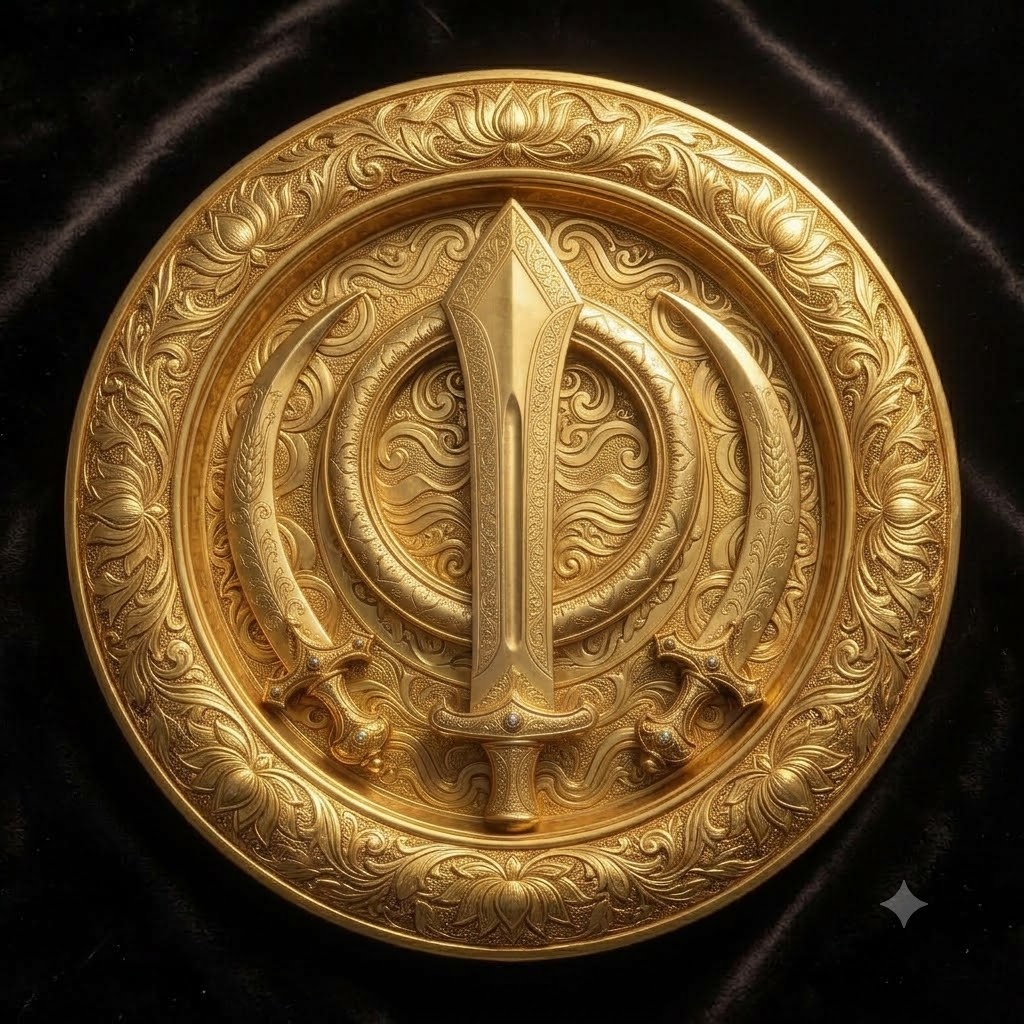
Soaring high upon the Nishan Sahib, the sacred Khanda crowns this sovereign sanctuary: the central double-edged blade representing unyielding divine truth, the endless circle (Chakkar) signifying the eternal unity of the Creator, and the two outer swords (Miri and Piri) declaring the inseparable balance of spiritual enlightenment and social justice. This is the one threshold on Earth where no seeker is an outsider, no belly remains empty, and every beating heart finds its home.
Nitnem
Nitnem is far more than a daily liturgy; it is the ultimate neuro-spiritual armor and chronobiological discipline designed to keep the human being unshakable. Centuries before modern chronobiology mapped circadian rhythms and neuroplasticity, Nitnem attuned human consciousness to the cosmic cycles of dawn, dusk, and rest. The morning nectar—Japji Sahib opens cosmic vision and intellectual clarity, Jaap Sahib and Tav Prasad Savaiye infuse fearless divine energy, Chaupai Sahib acts as an invulnerable shield against all existential dread, and Anand Sahib anchors the nervous system in unbroken inner bliss. At dusk, Rehras Sahib dissolves the weariness and moral compromises of the working day into gratitude, while night-time Kirtan Sohila purges the subconscious of anxiety, depression, and trauma before sleep. In a world besieged by relentless stress, warmongering, hatred, and social collapse, Nitnem re-engineers the human psyche into an oasis of calm—empowering individuals to stand as fearless protectors who vanquish malice and eradicate human suffering and hunger through selfless service. These sovereign banis are anchored directly within the Gutka hall of this court from our dedicated sanctuary files.
Hand in hand with this internal resonance, the Five Ks (Kesh, Kangha, Kara, Kachera, and Kirpan) stand as the sovereign uniform of an Amritdhari life—a living covenant of dignity and readiness to defend the weak. Yet the sanctuary of Sangat and the dining floor of Langar belong unconditionally to all humanity. Long before any code of discipline is adopted, every searching soul is greeted with pure love, open arms, and the first seat of honor.
Sehaj, Saptahik, and Akhand
This court hosts Sehaj Path: an unbroken, meditative walk through Sri Guru Granth Sahib Ji from Ang 1 to 1430. Pausing and resting are naturally permitted. The seat lock honors the sacred maryada of one devoted voice reading at a time. No Angs are skipped. The Bhog is not a mere closure —it is a sacred completion of reverence, prayer, and gratitude.
Saptahik Path is a structured, seven-day continuous reading, traditionally held in a Gurdwara through assigned reading rosters. This court does not run on a seven-day countdown clock and makes no claim to be a Saptahik Path.
Akhand Path is an uninterrupted, relay recitation spanning approximately forty-eight continuous hours without a single pause. This court does not enforce a 48-hour continuous cycle or a rotating roster of granthis. A Sangat Sehaj Path here honors your natural pace and may pause at any time—it is deliberate, mindful contemplation, not an Akhand Path.
Seat maryada
Sanctity of the Reader’s Seat (Pathi Maryada): Approach the seat with a covered head and a humble heart. To preserve meditative focus, only one sovereign voice reads at a time, and no Ang is ever skipped. Mindful pausing is naturally honored; however, an idle interval of about a minute (customizable by the sevadar) gracefully releases the seat so the next waiting reader may continue the seva without delay. Every reading sitting opens with heartfelt Ardas. At Bhog, the sacred Hukamnama is received and Karah Prasad (degh) is offered wherever feasible. Bhog represents the sacred, grateful culmination of the journey.
Visiting guests may view the public path card, while the sacred reader's seat is reserved strictly for a signed-in reader. Invited family members can see who currently holds the seva, binding the household in shared spiritual purpose. When enabled by the sevadar, the Listen-Along feature allows the wider Sangat to immerse in the recitation without altering reading progress. By anchoring the home in punctual discipline, mutual patience, and divine vibration, this maryada dissolves household friction, fosters deep emotional well-being, and surrounds daily family life with honor, peace, and grace.
Ardas, shukrana, chardi kala
Path parameters on a Sangat Sehaj Path represent the sanctuary’s conscious method of dedicating why a sacred reading is undertaken. They are not an additional scripture or dogma, but pure directional focus—aligning the household's shared energy toward peace, healing, and universal goodwill:
- Ardas (The Sovereign Petition): Standing in total surrender and humility before the living Word. On a path, "Ardas for" designates the heart of the sitting—whether undertaken for physical healing, family harmony, universal peace, or collective upliftment. It anchors prayer into tangible human action.
- Chardi Kala (Resilient High Morale): The state of unbroken, rising spirits and psychological invincibility under divine will (Hukam), even amidst adversity. In this court, Chardi Kala is not a casual slogan; it is an active spiritual technology that annihilates despair, anxiety, and defeatism from daily life.
- Shukrana (Profound Gratitude): The soul’s highest offering. A path may be dedicated in Shukrana for a divine Hukam received, the birth of joy and harmony within the household, or safe harbor through life's storms—dissolving entitlement into deep, peaceful contentment.
Family path and public path as seva
A Public Path is visibly anchored within Sangat Search as an open offering to the global court. Any signed-in reader may wait for the seat and seamlessly step forward the moment it is idle, carrying the sacred Word forward without disruption. Visiting guests may witness the public path card. This listing is an act of pure, ego-free Seva—offered generously to the wider court for collective elevation, never hoarded for personal recognition or status.
A Family Path operates strictly by invitation, shielded from public search to foster intimate household harmony. Family members can clearly see who currently holds the sacred seat, weaving distant hearts into a singular tapestry of mutual care and shared discipline. Invitations are delivered directly to the inbox; upholding total digital sanctity and privacy, this court stores a secure cryptographic hash rather than personal email addresses. Private walks remain exclusively with their creator—dissolving household friction, shielding the family from external anxieties, and inviting peace, moral strength, and spiritual abundance into daily life.
True Seva here is the sacred act of reading itself—a reverently covered head, one unified voice at a time, and never skipping an Ang. It is not an ego-driven scoreboard tracking who started the most paths, but a profound, timeless surrender into the living presence of the Word.